Bumping into friends on Flinders beach
28 August 2026
This was my first ever trip to Flinders beach. The first thing I noticed was its beauty. The second thing I noticed was the smell of the seaweed. Ash Barky did not notice the beach’s beauty, but she loved the smells. Her little stumped tail resembled a helicopter taking off.
According to a Mornington Peninsula Shire Council officers’ report (2025): “Allowing organic material to break down via natural processes on the coast can reduce carbon emissions, provide habitat and food for animals, provide nutrients to support plant growth, deposit seeds promoting natural regeneration and attenuate wave energy. These outcomes contribute towards a healthier coastal ecosystem and increase erosion resilience of our beaches.”
As I observed the beauty of the seaweed and other organic material on the foreshore, I reflected on our local councillors’ decision to ignore the scientific evidence and instead reintroduce mechanical raking to 80 per cent of the shire’s bay beaches, limiting hand-cleaning to those the machine cannot reach. I also reflected on how lucky were those who lived in Flinders. Unlike Mt Martha South beach, their beach was not subjected to human interference.
Almost immediately after arrival, Ash Barky had a poo. Here was the first problem: I could not find the poo amongst the seaweed. Some locals walked past telling me not to worry: “This happens all the time”. This led to a conversation comparing the environmental pros and cons of leaving dog poo on the beach versus collecting the poo in plastic bags, placing it in a bin and transporting it to landfill.
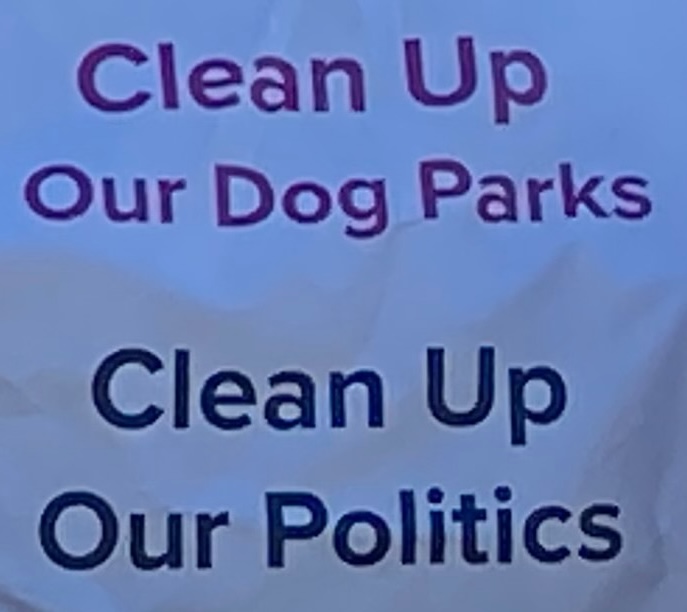
This also became a problem given the name of this community building exercise. How could we call our walks: Clean Up Our Dog Parks; Clean Up Our Politics” when I was unable to find Ash Barky’s poo?
It became immediately clear that my co-walker Bill and I were both keen chatterers with strangers. While I was discussing dog poo, he had started talking with a with a woman walking her lurcher who we soon discovered was a retired microbiologist. It took a very short time before we discovered mutual friends and acquaintances. Given our shared interests in environment, sustainability and politics, Barbara and her beautiful lurcher, Angus, accompanied us on our walk.
Barbara informed us about some concerning developments about council’s roadside weeding – are they using glyphosate-based herbicides? Has no one at council read Rachel Carson’s Silent Spring? Barbara also gave us an update on the Devilbend Foundation and the reservoir. Also her views about the Victorian Renewable Energy Terminal (the proposed wind farm port near Hastings). We shared phone numbers – and planned to stay in touch. Building community one step at a time.
Whilst listening to Bill and Barbara’s interesting conversation, I was watching Ash exploring her new and wondrous environment. At times, I found walking on the rocks was a bit tricky – so I was extra careful not to slip. Meanwhile Ash was hooning around with Angus. Clearly the dogs had no concerns about falling over.
Towards the end of the walk, a gorgeous kelpie came up to me. It was as though he knew me. As it turns out he did. When I asked the owner the dog’s name, he replied “Dusty”. Dusty had visited my home several times when a friend was looking after her.
I also bumped into a mate who worked as a climate scientist. We chatted briefly about the community independent movement before running off to join our respective friends. If our first “Clean Up Our Dog Parks; Clean Up Our Politics” walk is any indication, we are sure to bump into old friends (both human and canine) on our next walk in an off lead dog park during September.